Survey
Benno
Buying a sailing yacht is not only expensive, but also complicated. Taking shortcuts can be costly, even downright dangerous.
Our future yacht is advertised as being in very good condition, fully refitted and ready to sail. So really, it should be a safe purchase. Still, nobody in their right mind buys a 13-year-old yacht without a thorough professional survey. A check by a surveyor is also required by many insurance companies, and Swiss registration requires a seaworthiness certificate from a recognised expert.

On Monday, 09.11.26, the time had come: our expert Johannes from ShoreCrew flew in especially from Germany to put the yacht through its paces for two days. A survey like this usually follows more or less the same procedure. A professional skipper is hired to take the yacht out of the harbour for the sea trial. For insurance reasons, prospective buyers are not allowed to sail the yacht themselves. Our skipper normally runs a 70-foot superyacht and seems to have a lead foot: he tears out of the dock like a madman, and the broker turns pale as a sheet.
Once out at sea, the engines are tested under load, then the sails, and then we anchor for a while as we wait for our slot at the crane. So far, everything is in order. The yacht has new sails and a new rig. Those items alone cost close to twenty thousand euros and definitely need replacing after 15 years. On top of that, there is a new anchor and a new anchor chain. Good-quality ones also cost several thousand euros and are very important for safety on board. After all, you do not want the anchor chain to snap in a storm.
After that, the yacht comes out of the water. For this, you head to a marina with a suitable crane. It is quite an impressive machine, basically a high-rise building on wheels that is driven over the yacht. Straps are then passed underneath the yacht before the whole boat is hoisted into the air. Once out of the water, the entire hull below the waterline is cleaned with high pressure. Pressure washing is hard work, but it is well paid too. Cost for the lift and cleaning: more than 1,200 euros!
The hull below the waterline is examined very closely, because there is nothing a future yacht owner fears more than so-called osmosis. These boats are nowadays built almost exclusively from GFK, glass-fibre-reinforced plastic, often called fibreglass. It is little more than layers of plastic bonded together. If water gets between those layers, it can gradually dissolve the adhesive. The boat then essentially rots away beneath your feet, so it is rightly feared. If you do not want to give up on a boat with that diagnosis, it will need a very extensive repair.
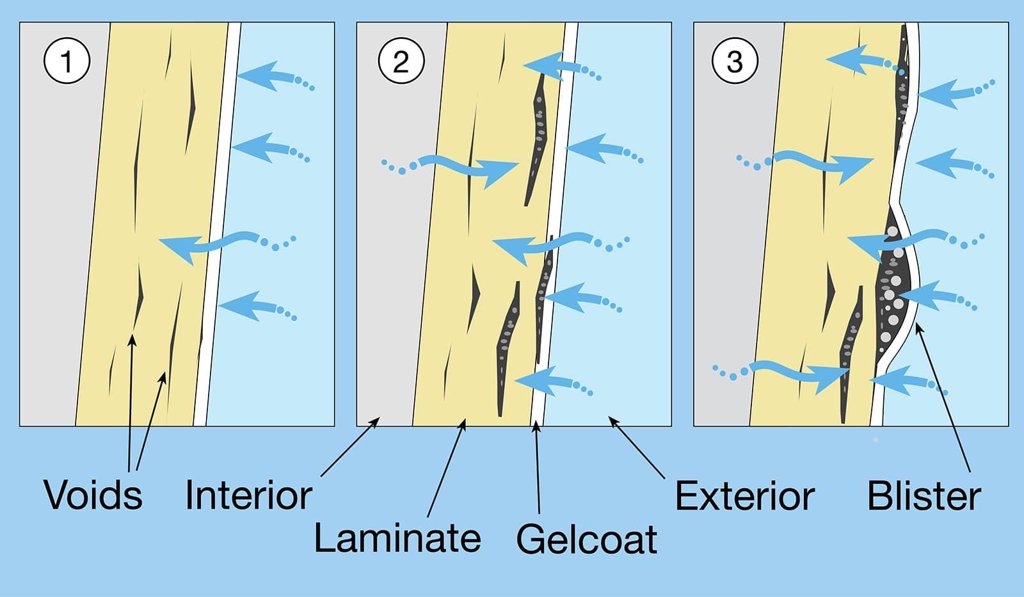
Osmosis is not easy to spot in its early stages. However, a well-built and well-maintained yacht should be largely safe from it. Johannes is confident that this yacht does not have osmosis.
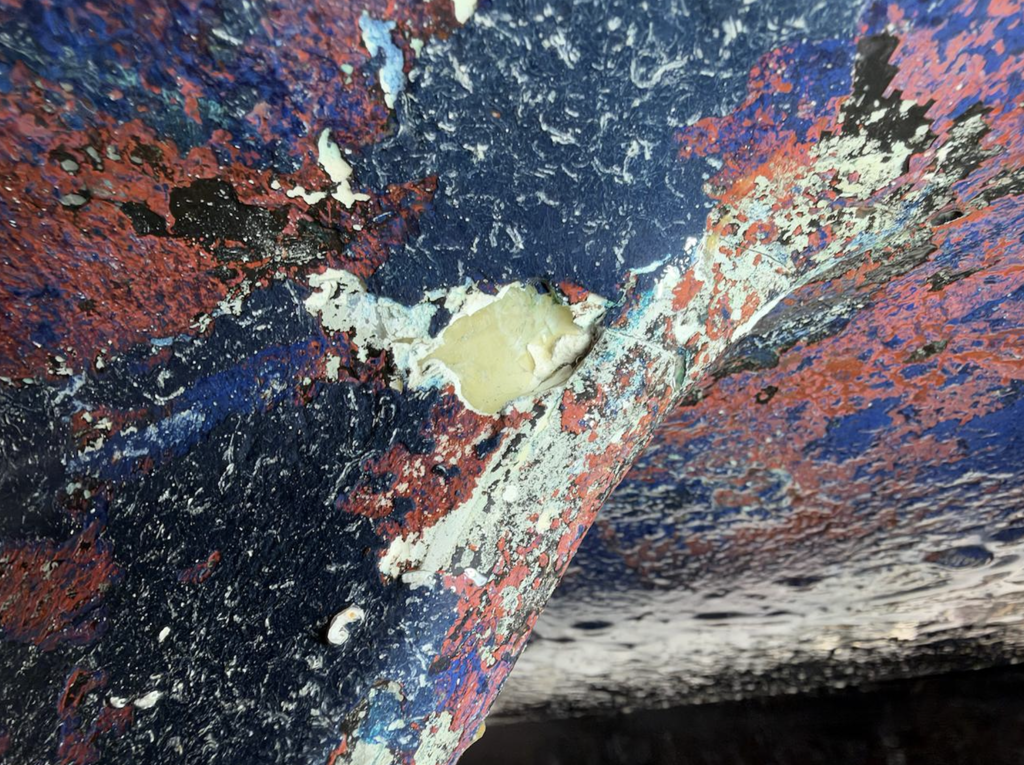
Even so, the hull below the waterline is showing every colour of the layers applied over the past 14 years. That will not do. It all has to come off and be redone. By coming off, I mean all those paint layers are removed by sandblasting, and then the protective coatings are reapplied from scratch. Cost: close to ten thousand euros, even in Greece. It is demanding, hard work when done properly. That is why it costs so much if you cannot or do not want to do it yourself.
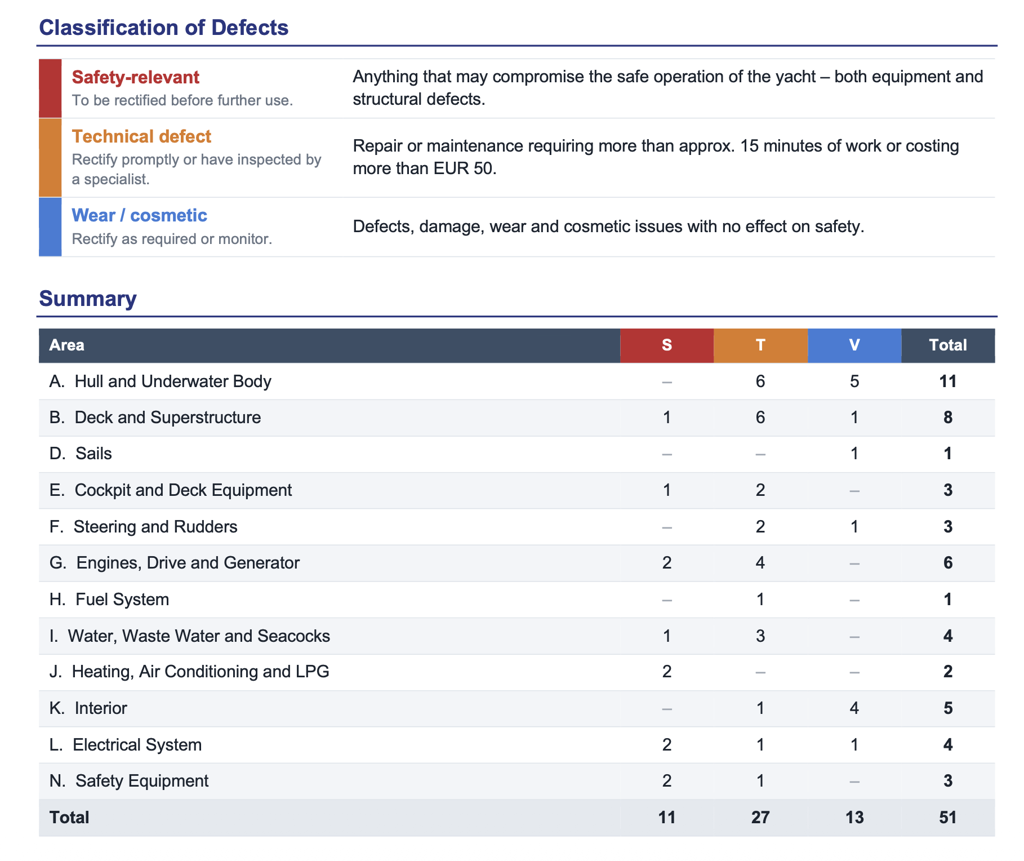
All in all, Johannes found 51 defects on a yacht that was supposed to be in very good condition. We estimate twenty thousand euros and a lot of work will be needed to put everything right again, because the little things add up too. For a turnkey yacht in very good condition, that is definitely too many issues needing attention.
The question now is: who pays for all this? In principle, under the contract signed by both parties, we are entitled to a yacht in very good condition at the agreed price. But as we have found out, what that means in detail is open to negotiation. Our proposal is this: the seller pays for the urgently needed work on the hull below the waterline, and we take care of the rest, in other words, fifty-fifty. We simply cannot afford anything else, as the purchase price has already taken us to the limit of our budget. The broker sees that action is needed and agrees with this proposal for the next round of negotiations.
The seller seems to be a proper old-school cheapskate, though, so it remains interesting. You will find out how it ends in the next post.
*This blog post has been automatically translated by a Large Language Model.